The Clinical & Engineering Problem
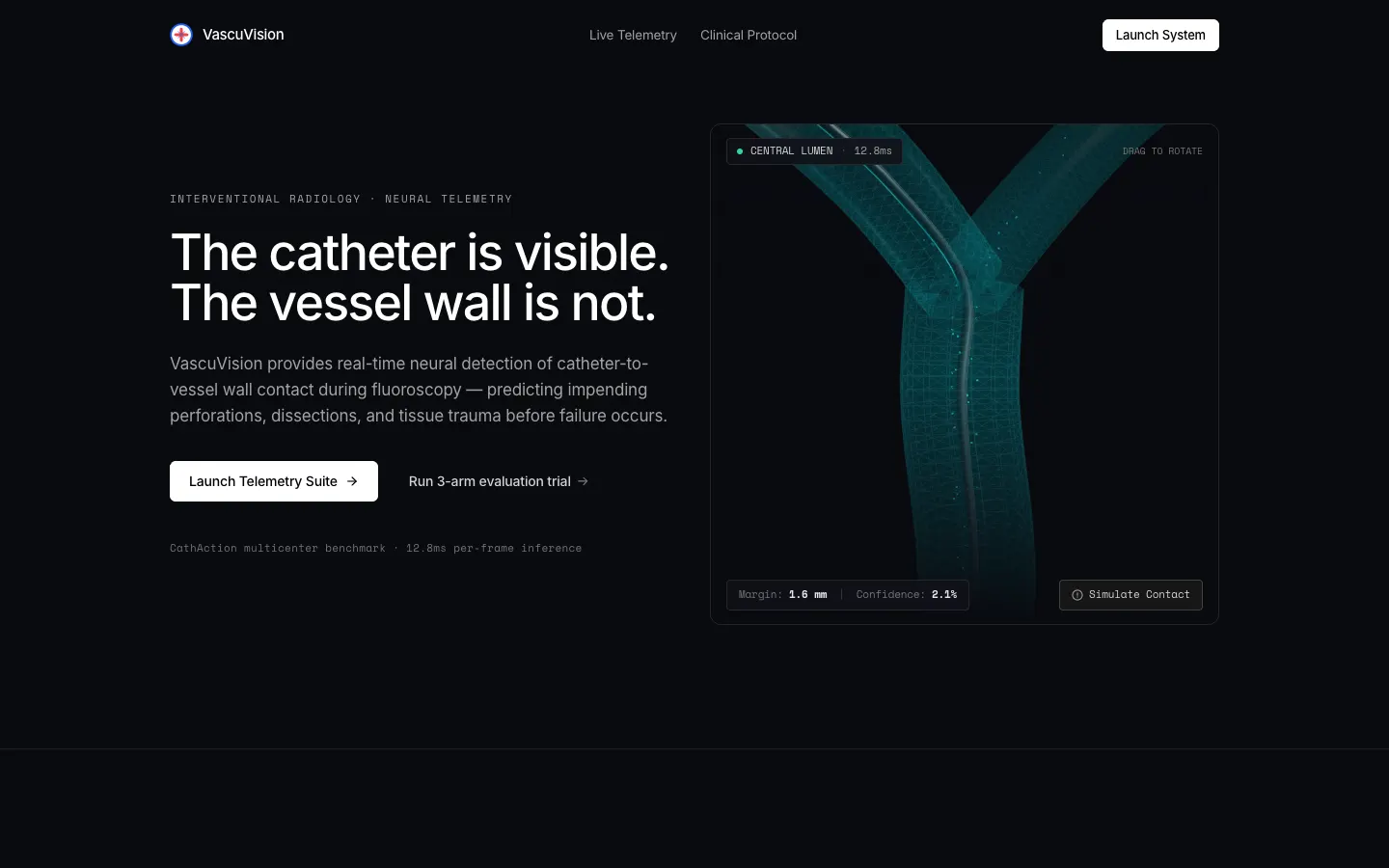
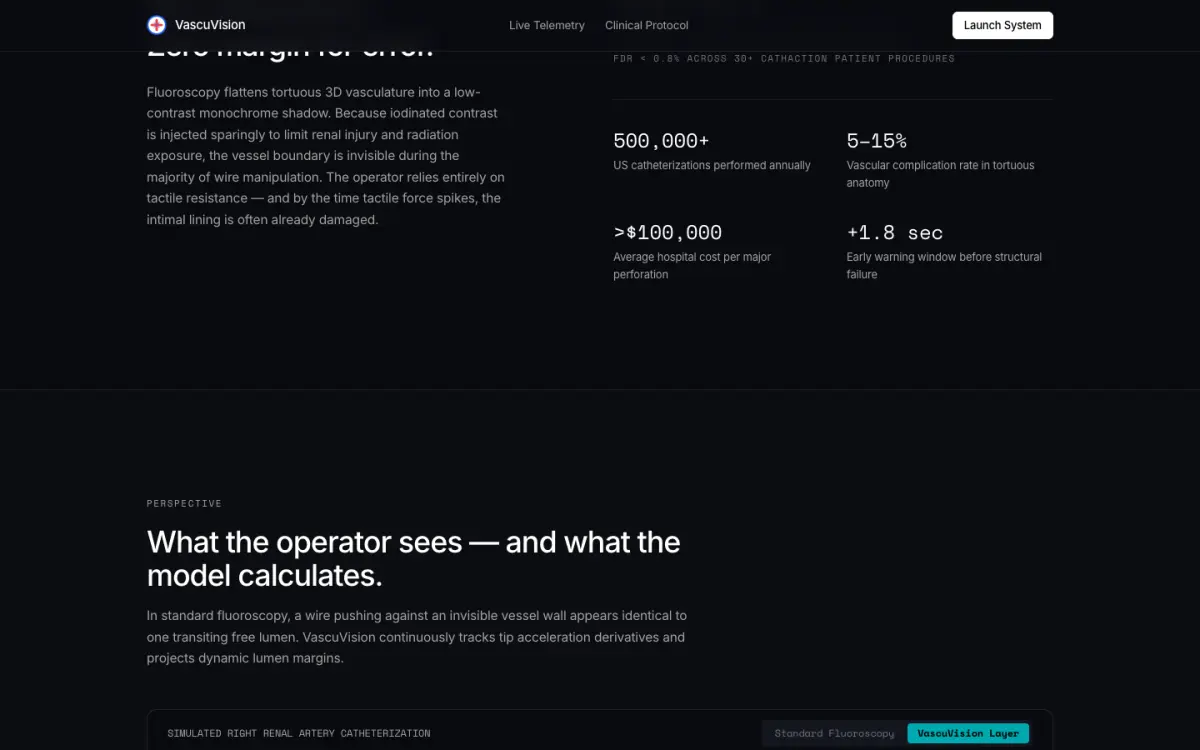
During fluoroscopic navigation, radio-opaque catheters and guide wires appear visually superimposed over invisible un-opacified vessel walls, making impending dissections and perforations difficult to foresee.
The Technical Approach
Blends real-time Euclidean distance transforms with deep spatial-temporal recurrent attention, tracking wire tip acceleration relative to projected lumen margins to compute a continuous collision risk waveform.
Engineering Architecture
- EfficientNet-B0 backbone extracting spatial feature embeddings from contrast frames
- 768-dimensional bidirectional recurrent network with multi-head attention over a 32-frame (2.1s) temporal window
- Continuous risk estimation combining projected lumen proximity (65%) and kinematic attention (35%)
- Interactive 3-arm evaluation trial testbed with synthetic benchmark cases and CSV metric export
Documented Evidence & Verification
12.8 ms
Frame Latency
Sub-15ms edge inference speed enabling intraoperative frame rates
1st Place
TX Neuroradiology
Scientific presentation recognized by Texas Society of Neuroradiology
Accepted
CIRSE 2026
Cardiovascular and Interventional Radiological Society of Europe poster
Deep-Dive Workflow View
Scientific Status & Regulatory Disclaimers
Research prototype developed for interventional radiology safety research and the SIR-MSC Biodesign Competition. Not cleared for real-time intraoperative guidance without clinical trial validation.