Actively remodel the aneurysm. Don’t just line it.

Remora is developing an active-remodeling endograft designed to address persistent endoleaks and reduce aneurysm sac diameter by a target of ≥10% through atraumatic mural suction and controlled plication.

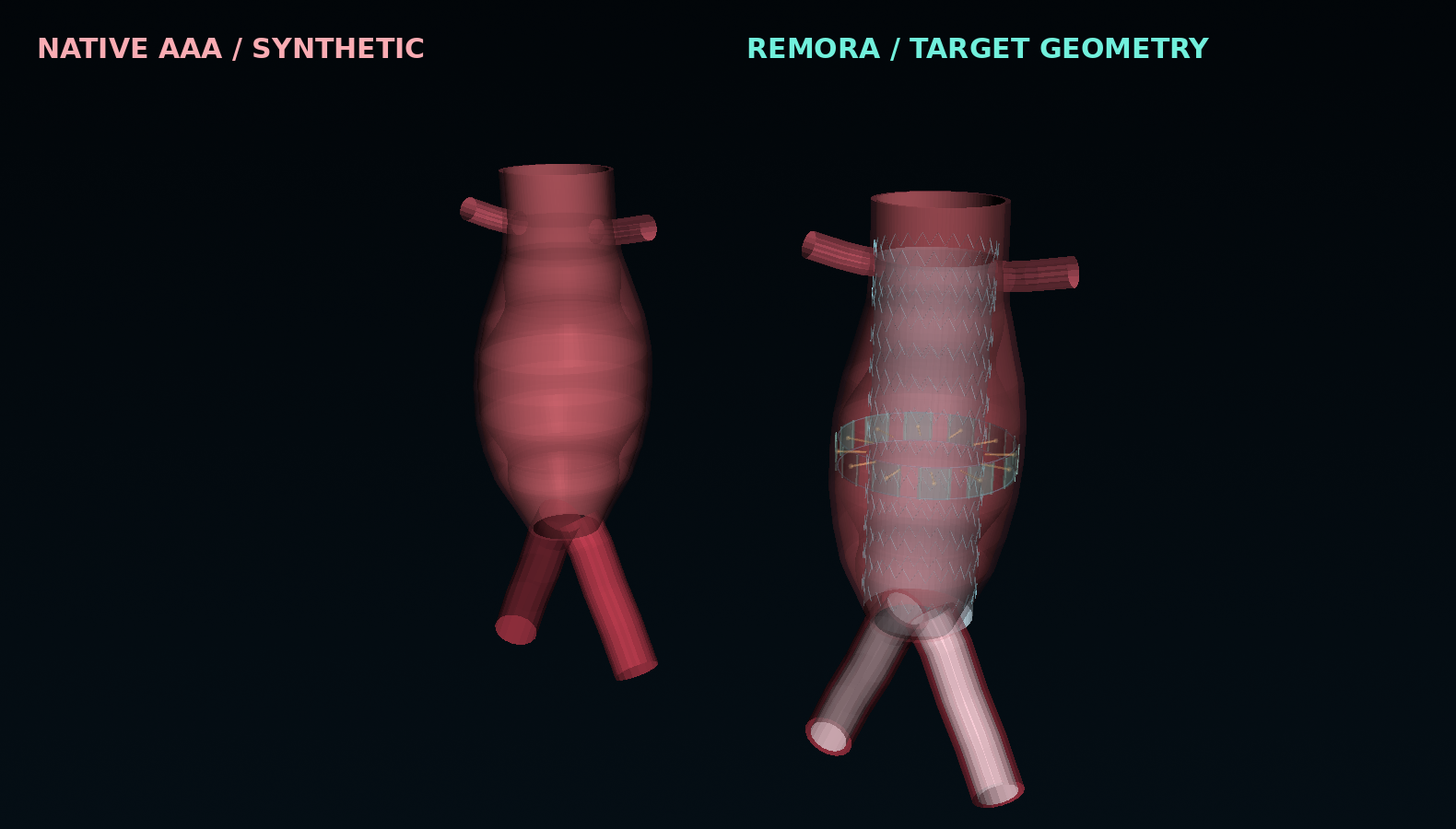
Remora deployment concept shown in synthetic abdominal aortic anatomy
Development stagePrototype + simulation
Evidence statusPreclinical concept
Regulatory statusInvestigational · not for sale
0%
Reported outcomePersistent endoleak after legacy EVAR
≥0%
Design targetAneurysm sac diameter reduction
0×
Biological referenceRemora disc adhesion vs. body weight
$0B
Market forecast2035 addressable AAA + TEVAR market
The problem

A quarter of repairs never
stop the disease.

Conventional EVAR redirects blood flow but leaves the aneurysm sac pressurised. The result is a lifetime of imaging, reintervention, and unresolved rupture risk.

0%
persistent
endoleak rate
Reported persistent endoleak rate following conventional passive stent-graft repair.
Model atlas

Three views of the current concept.

Explore the latest 3D anatomy and device renders: deployment context, chamber-level action, and the remodeled cross-section.

SYNTHETIC ANATOMY
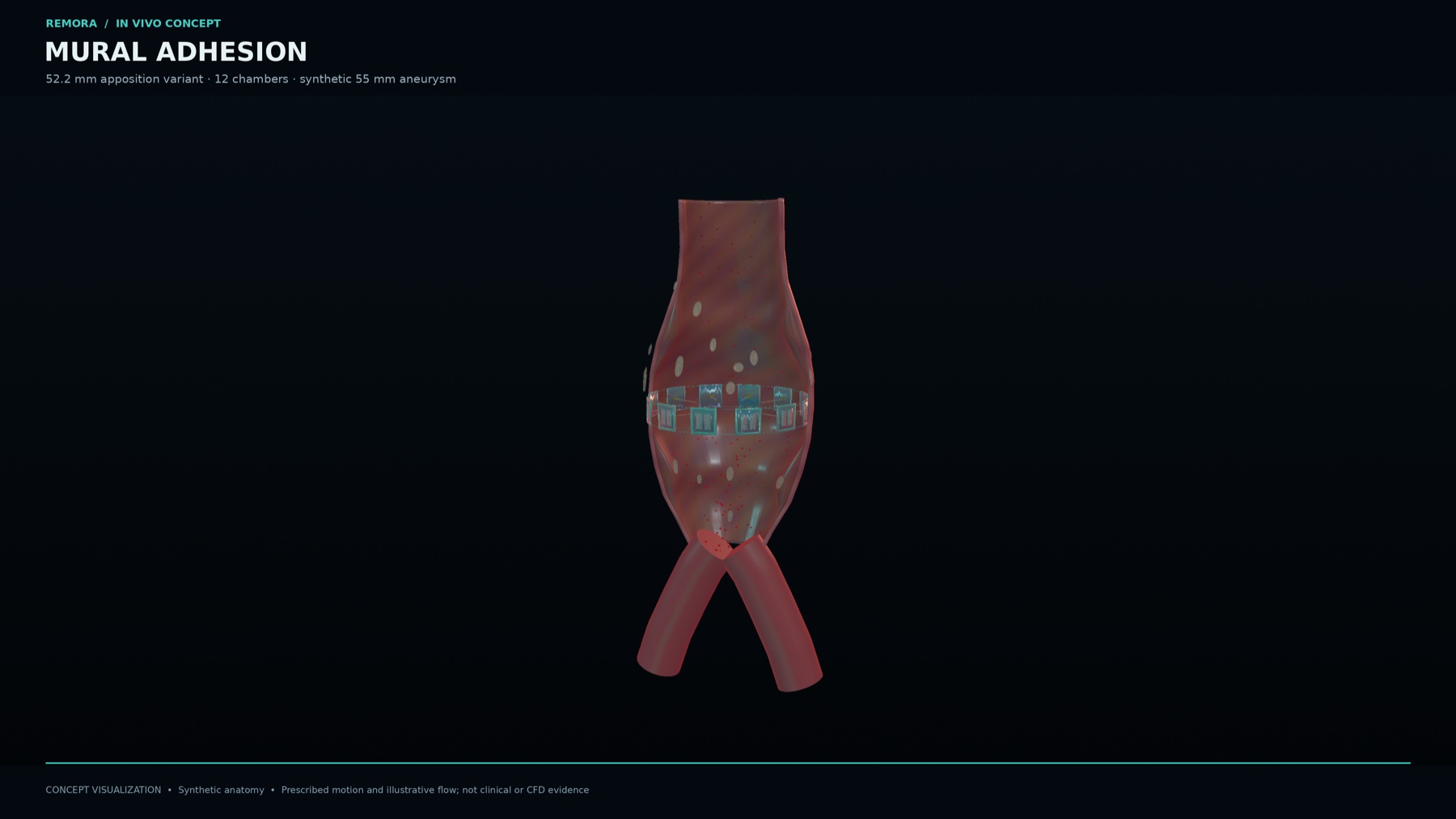
Wide 3D render of the Remora device deployed around a synthetic abdominal aortic aneurysm
01Deployment contextSynthetic AAA anatomy with the apposition concept and generic bifurcated graft.
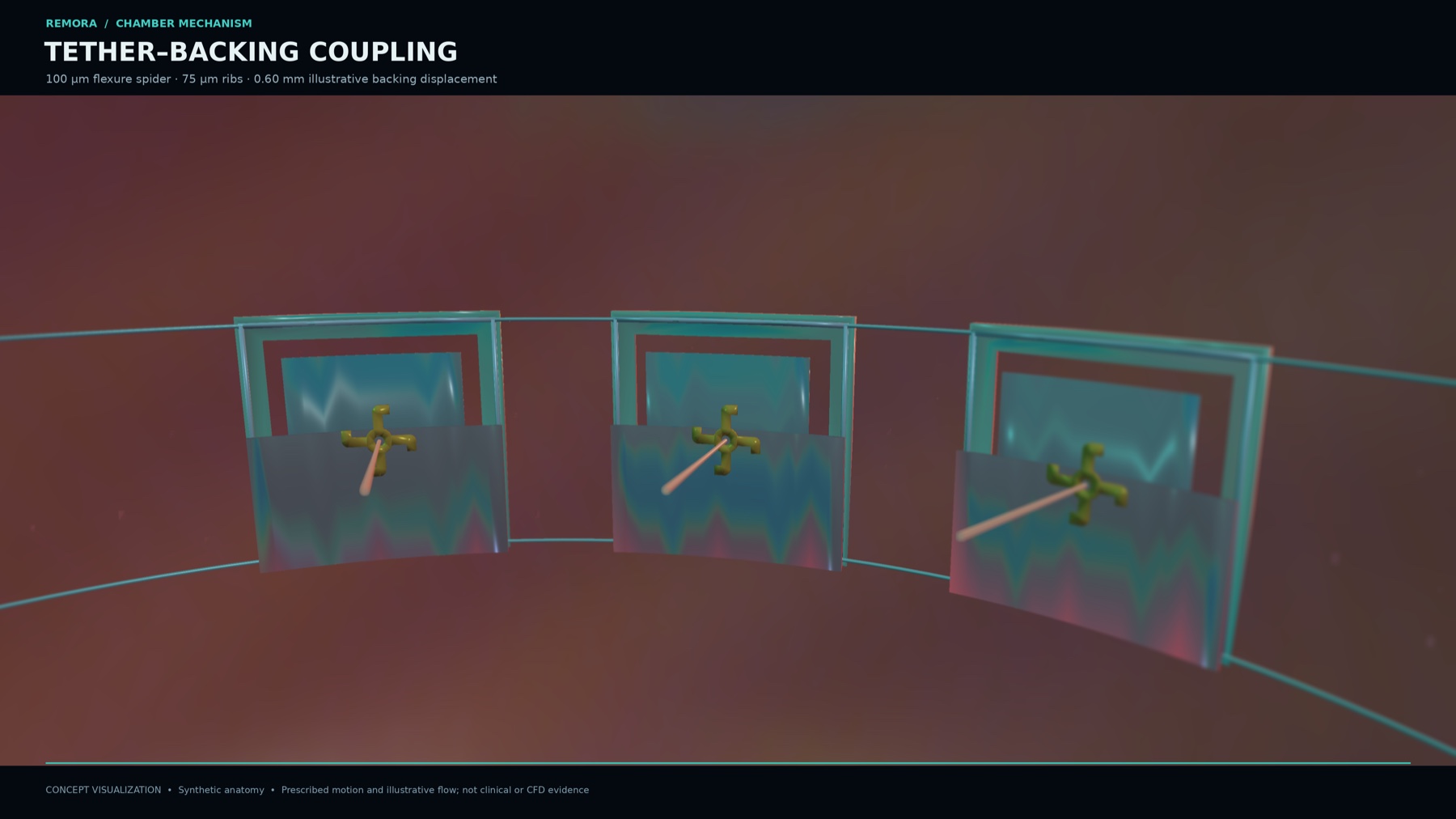
Close 3D render of the Remora chamber plication concept
02Plication actionMacro view of the chamber, tether path, and prescribed inward remodeling.
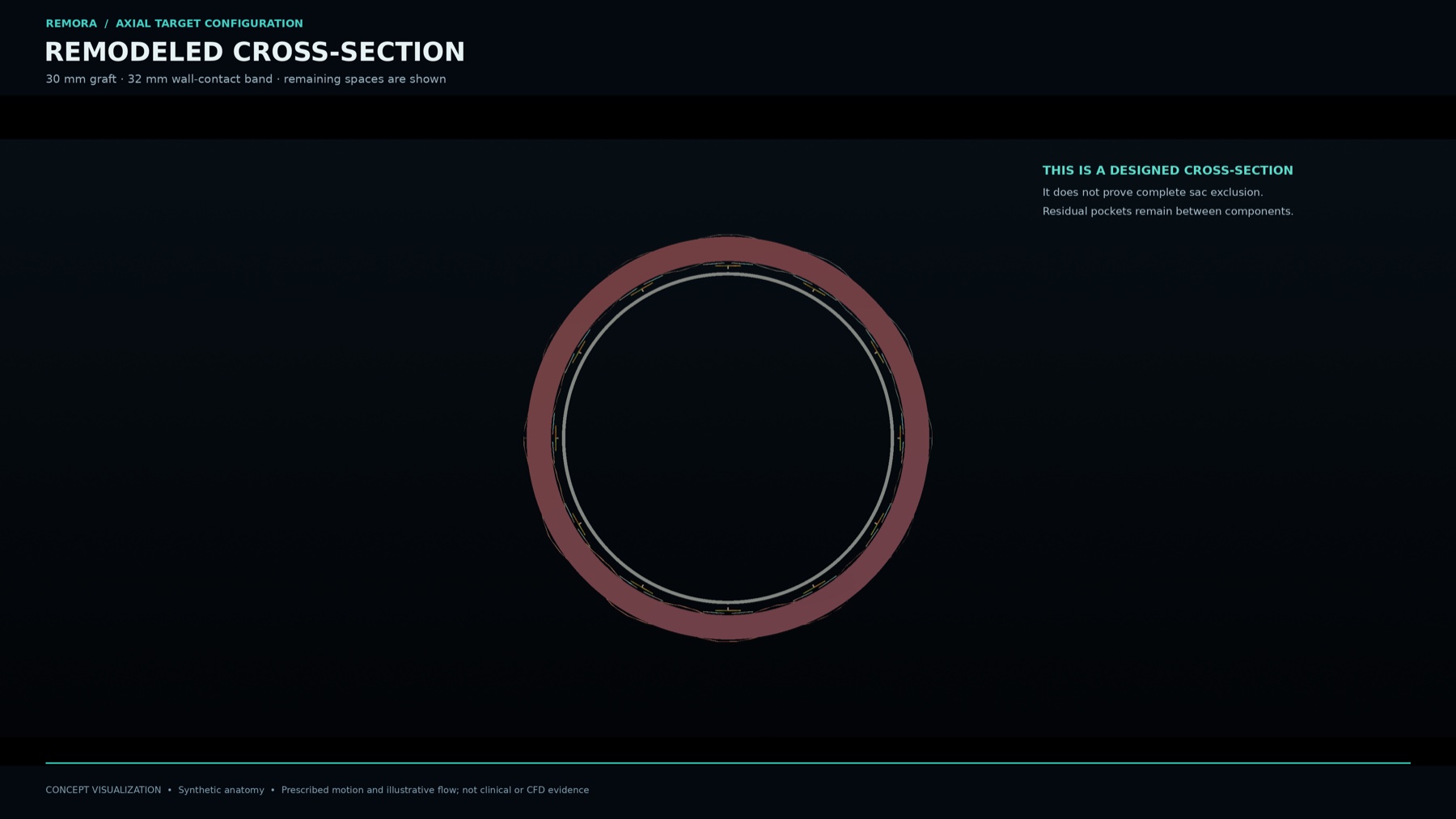
Axial 3D cross-section of the remodeled synthetic aneurysm concept
03Remodeled sectionAxial view of the target geometry, retained tissue, graft, and residual spaces.

Illustrative concept geometry only. These renders are not patient-specific, validated biomechanics, or evidence of safety or efficacy.

CONCEPT FILM / 0100:00 / 00:32  ·  SCROLL TO SCRUB

Synthetic anatomy and prescribed motion. Not clinical footage, patient-specific simulation, or evidence of safety or efficacy.

The mechanism

Inspired by the remora fish.

The remora's dorsal suction disc holds up to 340× its body weight against a moving host. We engineered a segmented, tension-activated attachment ring that brings that same stable suction to the pulsatile aorta.

01Delivery

Percutaneous catheter delivery

A low-profile femoral catheter tracks the endograft to the infrarenal aortic neck under fluoroscopy. No open exposure, no aortic cross-clamp, no cardiopulmonary bypass.

  • Femoral percutaneous access
  • Low-profile sheath compatible
  • Repositionable before commitment
02Anchoring

Biomimetic suction anchoring

A segmented, self-energizing attachment ring generates distributed sub-ambient pressure against the arterial wall. As the sac is pulled inward, tether tension expands sealed micro-cavities, actively generating suction.

  • Zero hooks, barbs, or perforation
  • Distributed circumferential load
  • Compliant to wall pulsation
03Remodeling

Active aneurysm sac plication

Coaxial drawstring members actively cinch sac diameter by a design target of ≥10%, collapsing the pressurised dead space that drives type-II endoleaks — converting a passive liner into an active remodeling therapy.

  • ≥10% diameter reduction target
  • Eliminates residual dead space
  • Single-session, one device
MECHANISM SIMULATION STAGE 01

Percutaneous delivery via low-profile sheath to the infrarenal neck. No open exposure.

FLOW CONCEPT / 0200:00 / 00:12  ·  SCROLL TO SCRUB
02 / Proposed mechanism

Active remodeling,
one frame at a time.

Illustrative flow and prescribed plication only. Not validated CFD, patient-specific simulation, or clinical evidence.

Interactive 3D Engineering

Simulated hemodynamics & mechanism kinematics.

Explore Remora's full 3D potential-flow CFD comparison and 5-stage deployment mechanism in our research-grade WebGL models.

Remora 3D AAA Flow Comparison and Mechanism Model Preview
Research Preview · October 2026

Two interactive 3D suites. Zero software required.

Directly orbit, inspect, and step through the synthetic AAA lumen, mural thrombus plication, and wall-contact suction dynamics in real time.

01 / AAA Flow Comparison

Pre-op baseline vs. post-plication flow velocity tracers projected into the 3D scene.

02 / Mechanism Explorer

5-stage timeline from catheter tracking to suction anchor engagement and plication lock.

Clinical contrast

From passive exclusion to active remodeling.

Conventional EVAR redirects flow. Remora is designed to pair exclusion with controlled sac plication and distributed fixation.

Legacy passive EVAR
28% endoleak rate
Conventional stent-grafts
  • Passive conduit. Excludes the lumen but does not actively reduce sac diameter.
  • Hook & barb fixation. Creates focal stress concentrations and vessel injury risk.
  • Lifetime surveillance. Annual CT imaging and repeat secondary interventions, indefinitely.
Remora active remodeling
≥10% sac reduction
Bio-inspired active endograft
  • Active sac plication. Cinches aneurysm diameter rather than only redirecting flow.
  • Atraumatic suction adhesion. Distributed fixation without intentional wall penetration.
  • Single-session repair. Targets the pressurisation that drives the surveillance burden.
Design pillars

Engineered around six commitments.

Circumferential fixation

Load distributed around the full vessel wall rather than concentrated at penetrating points.

Active remodeling

Mechanical work performed on the aneurysm, not merely a liner placed inside it.

Biomimetic geometry

Segmented attachment architecture derived from the mechanics of the remora's dorsal adhesion disc.

Simulation-first

Fluid-structure interaction models drive geometry decisions before a single part is cut.

Atraumatic by default

No barbs, no hooks, no intentional wall penetration anywhere in the fixation path.

Workflow-compatible

Built for existing percutaneous femoral workflow and standard interventional suites.

Market

A large market with a persistent clinical gap.

Aortic repair is a large, growing, reimbursed market where the incumbent standard of care still carries a meaningful burden of persistent complications.

2035 addressable market
$0B

Combined abdominal (AAA) and thoracic (TEVAR) endovascular repair.

Failure to displace
0%

Share of legacy repairs with persistent endoleak — a reintervention pipeline, not a cure.

Clinical wedge
≥0%

Sac reduction target — the differentiating outcome no passive graft can claim.

Roadmap

Where we are.

We are executing Stage 1 today. Stages 2 through 4 are planned and gated on the pre-seed round.

S1

Stage 1 — Prototyping & FSI simulation

Evaluating computational fluid-structure interaction hemodynamics and building bench prototyping models of the adhesion disc.

Active stage · Pre-seed $500K ask
  1. 1
    Now

    Prototyping & FSI simulation

    Computational hemodynamics, adhesion-disc geometry iteration, and first bench articles.

  2. 2
    Planned

    Benchtop validation

    Pulsatile flow-loop testing of fixation strength, plication force, and migration resistance.

  3. 3
    Planned

    Preclinical proof-of-concept

    Large-animal deployment and durability studies against predefined acute endpoints.

  4. 4
    Planned

    Regulatory pathway

    Design-control freeze, pre-submission engagement, and early feasibility study strategy.

Founders

Built across engineering, R&D, and clinical strategy.

Four co-founders spanning engineering, R&D, and clinical strategy.

Joshua Robert
Joshua Robert
Co-Founder & Lead

Device architecture, simulation strategy, and fundraising.

Ethan Edwards
Ethan Edwards
Co-Founder & Engineering

Mechanism design, prototyping, and benchtop test development.

Likhitha Veerapalli
Likhitha Veerapalli
Co-Founder & R&D

Materials, adhesion characterisation, and experimental design.

MaryGrace Wahby
MaryGrace Wahby
Co-Founder & Clinical

Clinical need definition, endpoints, and regulatory groundwork.

Pre-seed · $500K

Interested in partnering?

We are raising a $500K pre-seed round to fund bench prototyping and preclinical proof-of-concept. Request the full investor overview.

The investor deck is passphrase-protected. Request access.